Afar fossil shows broad distribution and versatility of Paranthropus
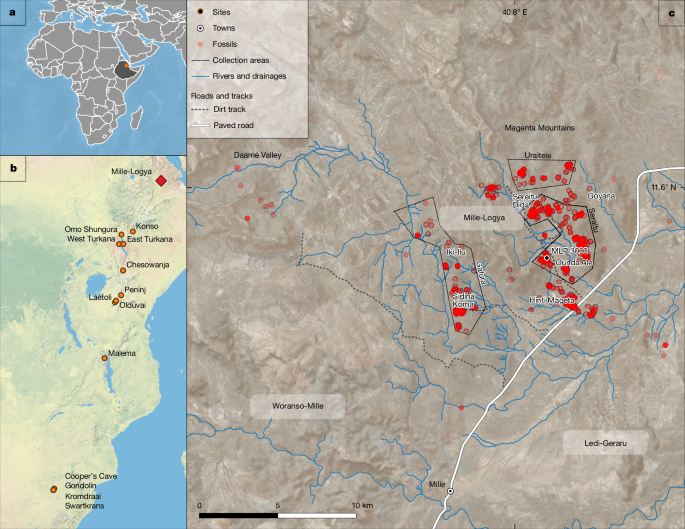
The Afar depression in northeastern Ethiopia contains a rich palaeontological and archaeological record, which documents 6 million years of human evolution. Abundant faunal evidence links evolutionary patterns with palaeoenvironmental change as a principal underlying force1. Many of the earlier hominin taxa recognized today are found in the Afar, but Paranthropus has been conspicuously absent from the region. Here we report on the discovery, in the Mille-Logya research area, of a partial mandible that we attribute to Paranthropus, dated to between 2.5 and 2.9 million years ago and found in a well-understood chronological and faunal context. The find is among the oldest fossils attributable to Paranthropus and indicates that this genus, from its earliest known appearance, had a greater geographic distribution than previously documented2. Often seen as a dietary specialist feeding on tough food, the range of diverse habitats with which eastern African Paranthropus can now be associated shows that this suggested adaptive niche did not restrict its ability to disperse as widely as species of Australopithecus and early Homo. The discovery of Paranthropus in the Afar emphasizes how little is known about hominin evolution in eastern Africa during the crucial period between 3 and 2.5 million years ago, when this genus and the Homo lineage presumably emerged. With its attribution to Paranthropus, a 2.6-million-year-old partial mandible expands the range of the genus into the Afar region of Ethiopia and adds to our understanding of hominin evolution in eastern Africa.

Nature reports on Afar fossil shows broad distribution and versatility of Paranthropus
Villaseñor, A., Bobe, R. & Behrensmeyer, A. K. Middle Pliocene hominin distribution patterns in Eastern Africa. J. Hum. Evol. 147, 102856 (2020).
Wood, B. & Strait, D. Patterns of resource use in early Homo and Paranthropus. J. Hum. Evolution 46, 119...